Why It's So Hard to Leave: Understanding Trauma Bonding in Spiritual Abuse

Understanding Trauma Bonds in Spiritual Contexts:
A trauma bond is a strong emotional attachment that forms between a person who has been harmed and the person harming them.
Note: Please be aware that this article contains discussion of spiritual abuse and grooming, and their psychological effects. Readers who have experienced grooming or abuse in religious settings may find some content activating. If you are currently working with a therapist or psychologist, you may find it helpful to read this alongside that support. If you are not, and you find the content distressing, please consider reaching out to a mental health professional. Support is available through: Lifeline: 13 11 14 (24 hours) Beyond Blue: 1300 22 4636 (24 hours) 1800RESPECT: 1800 737 732 (national sexual assault, domestic and family violence counselling service, 24 hours). Full Stop Australia: 1800 385 578 (24 hours, formerly CASA). Beyond Blue online chat: beyondblue.org.au 1800RESPECT online chat: 1800respect.org.au
When people step away from a harmful relationship, particularly one that took place inside a church, mission, ministry, or spiritual community, they often look back and ask the same painful questions. How did I not see it at the time? Why did I keep going back? Why, even now, do I sometimes miss the person who caused me to feel so much pain?
One phenomenon that explains the strong bond that occurs between an abuser and their victim is called trauma bonding. Trauma bonding is a predictable psychological and biological response to a specific pattern of relationship dynamics. The word bond does not necessarily signal that anything romantic or sexual is occurring, although this can occur in sexually exploitative relationships and intimate partnerships. Rather, the bond refers to an attachment bond that can occur in any caregiver relationship, or in many other types of relationships. Understanding how trauma bonds form, especially easily in spiritual settings, can be an important part of making sense of your experience.
Please read first. This article describes a general psychological concept and the patterns people commonly experience. It is not intended to characterise, diagnose, or make any claim about a particular person's behaviour, motivations, or intent. The dynamics described here can arise in many different kinds of relationships and for many different reasons — sometimes through deliberate harm, sometimes through someone's own unresolved struggles, and often somewhere in between. How any of this fits, or doesn't fit, your own situation is something best made sense of in supported conversation, ideally with a therapist who understands these dynamics.
What is a trauma bond?
A trauma bond is a strong emotional attachment that forms between a person who has been harmed and the person harming them. When people step away from abusive relationships, they often look back and wonder how it happened — and experience self-blame when they realise there were times they returned even after the harm was evident. Trauma bonding is one way of describing what continues to pull you back toward the relationship even when there is a growing sense that it is unsafe. It also helps explain why some people find it hard to fully leave, or to hold the person who harmed them accountable.
This is not a sign of weakness, poor judgement, or love gone wrong. It is a predictable psychological and biological response to a specific pattern of relationship dynamics.
Where the term comes from
The concept of "traumatic bonding" was first described by psychologists Donald Dutton and Susan Painter in 1981. They were researching why women returned to abusive partners after leaving, and noticed something that seemed to defy ordinary logic: the strength of the emotional attachment did not weaken with abuse — it often intensified.
Dutton and Painter identified two structural features that make trauma bonds form:
A significant power imbalance — one person holds substantially more control (financial, social, spiritual, physical, or emotional), creating dependency in the other.
Intermittent reinforcement — cruelty, criticism, or harm are unpredictably mixed with warmth, affection, apologies, or moments of what feels like genuine care.
Drawing on behavioural psychology, they pointed out that unpredictable rewards produce the strongest and most extinction-resistant attachments — far stronger than consistent kindness ever would. In a relationship, this means it is hope, not just fear, that holds the bond in place. The good moments are not evidence that the relationship is fine — they are part of what makes it so hard to leave.
Why you often feel drawn back into the abusive relationship
In 1997, Dr Patrick Carnes expanded this work to look at what happens in the body and brain. The cycle of threat → fear → relief → reconciliation triggers powerful releases of stress chemicals (cortisol, adrenaline) and reward chemicals (dopamine, oxytocin). Over time, this conditions the nervous system to seek comfort from the very person causing the distress.
Carnes likened this to chemical addiction where the bond is strengthened by the brain's reward circuitry, which is why it can feel as overpowering and difficult to break as a substance dependency. This helps explain experiences survivors often describe:
Craving contact with the person who hurt them
Withdrawal-like distress when separated
Intense relief or euphoria when the person is kind again
Difficulty trusting one's own perception of what happened
Similar psychological concepts to Trauma Bonding
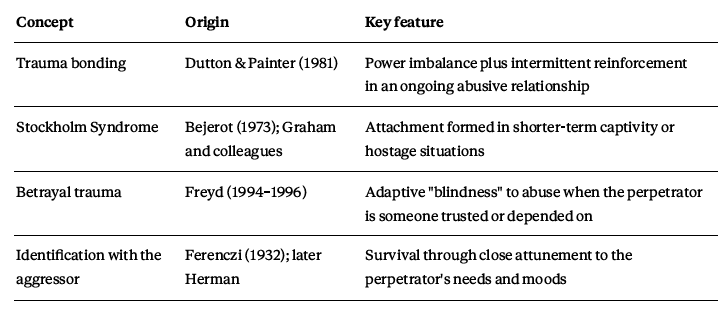
Trauma bonding sits alongside several related ideas such as Stockholm Syndrome (Bejorot, 1973), betrayal trauma (Freyd, 1994), and identification with the aggressor (Ferenczi, 1932). Each of these concepts overlap, but each describes a slightly different situation (see the table below for the key features of each of these concepts).
A newer understanding: the bond is built, not just "developed"
Older models often framed trauma bonds as something that "developed", almost passively, through the survivor's own attachment patterns or codependency. More recent thinking, including research from the University of Cambridge, reframes the bond as something actively constructed through the behaviour of the person doing the harm: love bombing, grooming, personal disclosures that create a sense of specialness, and strategically timed warmth. These behaviours build the bond, often long before any obvious abuse begins.
It is worth holding some nuance here. Sometimes this is done with cold, deliberate intent — a predatory pattern. Other times, it is driven by subconscious drives. Both can cause real harm. Regardless:
The early closeness, the moments of care, and the personal trust built in those first stages are not evidence against abuse. They are part of how the bond was constructed, whatever the other person's intent.
Responsibility for the harm sits with the person who caused it, not with you for responding the way human beings respond to that pattern of behaviour.
When Trauma bonding occurs in spiritual contexts
Trauma bonds can form in any relationship that involves power imbalance and intermittent reinforcement. But spiritual contexts — churches, missions, ministries, religious communities, wellness movements with charismatic teachers — are particularly fertile ground for them. This is not because all spiritual leaders are manipulative. The vast majority are not. It is because the structural features that make trauma bonds form are already built into the role before any individual leader steps into it.
Several factors come together to make this so.
The power imbalance is pre-existing and morally framed. In most relationships, power has to be established over time. A pastor, mission president, priest, rabbi, bishop, or spiritual teacher arrives with authority already in place — and that authority is framed not just as positional, but as spiritual or divine. The leader is not simply a person with a job; they are positioned as a representative of God, a vessel of revelation, a person of greater spiritual maturity. Submission to them is not just expected, it is often presented as virtuous, and questioning them as sinful, prideful, or rebellious. The structural conditions for a trauma bond exist before the first conversation has even taken place.
People come to spiritual leaders in vulnerable states. People rarely walk into a pastor's office, a confessional, or a bishop's interview feeling robust. They come during grief, doubt, transition, marital difficulty, sexuality questions, spiritual crisis, or shame. They come because they need help. This means the relationship begins with an asymmetry not just of role, but of internal state — and the leader sees the person at their most exposed before that person sees the leader as anything other than someone there to help.
Disclosure is built into the relationship. Worthiness interviews, confession, pastoral counsel, prayer requests, and spiritual direction all involve disclosing deeply personal material — including doubts, sexual experiences, struggles with addiction, marital conflict, mental health, and shame. The level of personal vulnerability shared with a spiritual leader is often greater than what is shared with anyone else in the person's life, including spouses or close friends. This rapid, structured, one-way disclosure creates a profound sense of being seen and known — one of the most powerful early ingredients in any close bond.
Warmth from a spiritual leader carries extra weight. When a pastor expresses care, attention, or admiration, it is not simply experienced as personal warmth. It can be felt as evidence of being divinely seen — that God, through this person, is acknowledging your worth, your specialness, your calling. The early investment a spiritual leader makes — personal disclosures of their own, expressions of confidence, mentorship, time, attention — does the same work as love bombing in a romantic context, but with an added layer: these moments feel sacred. The bond is not just personal; it is positioned as part of one's spiritual life and identity.
Grooming, in spiritual contexts, often looks indistinguishable from genuine ministry. Time alone, frequent contact, personal disclosures, expressions of being "called" or "led" to invest in this particular person, mentorship language, prayer together — these can all be exactly what a healthy spiritual relationship looks like. They can also be the architecture of grooming. The behaviours themselves do not always tell you which is which; the pattern, the power dynamics, and what follows do. This is part of why spiritual abuse can be so difficult to name early — the early stages can feel, and look, like blessing.
Doubt about the leader becomes doubt about God. This may be the most powerful binding mechanism of all. When the leader is positioned as a representative of the divine, distrusting them, leaving them, or holding them accountable can feel like distrusting, leaving, or rejecting God. The cognitive and emotional cost of leaving is not just relational, it is existential. Survivors often describe feeling that to acknowledge harm done by the leader would be to unravel their entire spiritual world — their understanding of God, their sense of meaning, their identity, their afterlife.
The community reinforces and protects the bond. Spiritual abuse rarely happens in isolation. The community has often invested its own identity in the leader and the institution. To name harm is to risk relationships, belonging, family standing, and sometimes housing or employment. Survivors are frequently met with disbelief, minimisation, or active protection of the leader — which compounds the trauma and adds another layer of bonding: the leader can come to feel like the only person who fully knew what happened.
Eternal stakes amplify everything. In traditions where salvation, exaltation, or the wellbeing of one's family in the afterlife is framed as conditional on remaining in good standing, the cost of leaving — or of accusing — extends beyond this life. The intermittent reinforcement that drives all trauma bonds takes on cosmic proportions: warmth from the leader can feel like a sign of one's standing with God; coldness or chastisement can feel like a glimpse of damnation.
When you take all of these together, it becomes clearer why so many survivors of spiritual abuse describe a bond that feels not just strong but sacred — and why disentangling from it can feel like more than recovery from a relationship. It can feel like rebuilding a whole world.
What this might mean for you
If you are recognising your own experience in this material, some things worth holding in mind:
Your attachment, or feelings of pity, obligation, or sympathy for the person who harmed you, is not proof that the relationship was healthy, or that the harm did not happen.
The fact that you often returned to the relational dynamic that was causing you harm does not make you responsible for the other person's actions, and it does not make the abuse your fault.
The good moments you remember may be real. People are rarely all bad, and most have vulnerable, kind, and thoughtful moments. This is part of how the bond was built — a person does not need to be "painted all black" to be seen as someone who is harmful or abusive.
Confusion, longing, and grief alongside anger are all expected when you are recovering from abuse. They are not contradictions.
If you still find yourself drawn to the person — looking for them in a room, reading their old messages, or catching yourself wanting to tell them about your day — this is not likely a sign that you are weak, broken, or that you secretly want to return. It is the echo of a deeply conditioned pattern, and it eases as the bond loosens.
Recovery is usually gradual and non-linear. The bond can loosen with time, understanding, and support.
A note on getting support
Untangling a trauma bond — especially one formed in a spiritual context — is rarely something people do alone, and it is rarely something that resolves on a tidy timeline. What helps most is being able to think through your experience with someone who understands these specific dynamics: how power, vulnerability, sacredness, and harm can become entwined, and how the nervous system holds the imprint long after the relationship has ended.
If any of this resonates and you would like to talk to someone about your own experience, you are welcome to get in touch. You do not need to have all the words for what happened. You do not need to be sure of how to describe the person who hurt you. You only need to be willing to begin.
At Refuge Psychology, I offer evidence-based counselling and support for those recovering from religious trauma and spiritual abuse. My approach is collaborative and faith-sensitive. I will not attempt to change your beliefs but will support you in a way that is consistent with them. To learn more or to book an appointment, click here:
To make contact or to book an appointment, click here:
Disclaimer: Any stories or examples provided are an example only and do not describe a specific client, person or event. Some of the information we provide on our website may be information related to health and medical issues, but it's not meant to be health and medical "advice". We provide this information for your general use only. While we try to provide accurate information, it may be historical, incomplete information or based on opinions that aren't widely held. Your personal situation has not been considered when providing the information, so any reliance on this information is at your sole risk. We recommend seeking independent professional advice before relying on the information we provide. Find the full terms of service here: Terms of Service | Refuge Psychology
Key references
Dutton, D. G., & Painter, S. L. (1981). Traumatic bonding: The development of emotional attachments in battered women and other relationships of intermittent abuse. Victimology, 6(1–4), 139–155.
Carnes, P. (1997). The betrayal bond: Breaking free of exploitive relationships. Health Communications.
Freyd, J. J. (1996). Betrayal trauma: The logic of forgetting childhood abuse. Harvard University Press.
Graham, D. L. R., Rawlings, E. I., & Rigsby, R. K. (1994). Loving to survive: Sexual terror, men's violence, and women's lives. NYU Press.
Ferenczi, S. (1932/1949). Confusion of tongues between adults and the child. International Journal of Psycho-Analysis, 30, 225–230.
Recent research from the University of Cambridge on coercive control and the deliberate construction of trauma bonds.